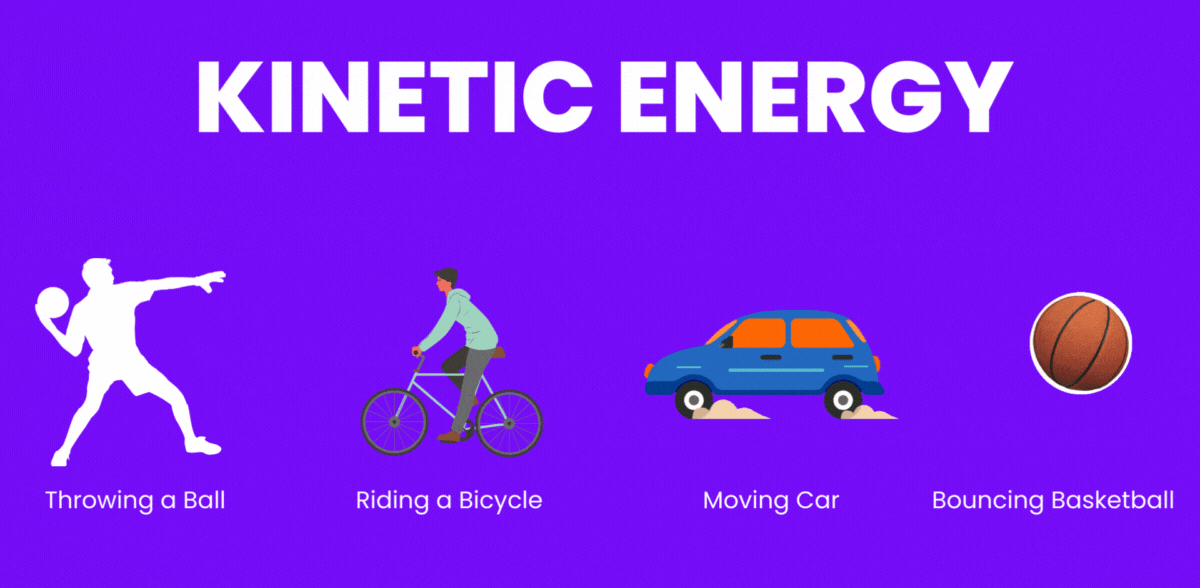
Kinetic energy is one of the easiest types of energy to understand because we see it around us every day. Whenever something moves, it has kinetic energy. A rolling football, a running child, a moving car, flowing water, spinning fan blades, and even tiny particles inside matter all have kinetic energy because they are in motion. In simple words, kinetic energy is the energy an object has because it is moving. The faster an object moves, the more kinetic energy it has. Also, the heavier the object is, the more kinetic energy it can carry when it moves. This idea helps us understand many daily events, from sports and transport to electricity generation and natural disasters.
What Is Kinetic Energy?
Kinetic energy is the energy of motion. An object does not need to be alive or powered by an engine to have it. It only needs to move. A stone falling from a height has kinetic energy. A bicycle moving on the road has kinetic energy. A bird flying in the sky has kinetic energy. Even air moving as wind has kinetic energy. This energy depends mainly on two things: the mass of the object and its speed. Mass means how much matter an object contains, while speed means how fast it is moving. A large truck moving at the same speed as a small bicycle has much more kinetic energy because the truck has greater mass. In the same way, a car moving very fast has more kinetic energy than the same car moving slowly.
The basic formula for kinetic energy is:
Kinetic Energy = 1/2 × mass × velocity²
This formula shows that speed has a very strong effect on kinetic energy. If the speed of an object doubles, its kinetic energy becomes four times greater. This is why fast-moving vehicles can be dangerous. A small increase in speed can create a much larger increase in energy. That energy must go somewhere if the vehicle stops suddenly, which is why crashes become more serious at higher speeds.
Simple Explanation for Beginners
To understand kinetic energy, imagine pushing a shopping cart. When the cart is still, it does not have kinetic energy because it is not moving. When you push it, you do work on the cart. Your force makes it move, and the cart gains kinetic energy. If you push harder, the cart moves faster and gains more kinetic energy. If the cart is full of heavy items, it needs more effort to move because it has more mass. Once it is moving, it also has more kinetic energy than an empty cart moving at the same speed.
This example shows the relationship between force, work, motion, and energy. Work is done when a force moves an object over a distance. When work is done on an object, energy is transferred to it. If that energy causes the object to move faster, the object gains kinetic energy. This is a key idea in physics, but it is also easy to observe in everyday life.
Main Types of Kinetic Energy
Kinetic energy can appear in different forms depending on the type of motion. The first type is translational kinetic energy, which happens when an object moves from one place to another. A car driving down a road, a ball flying through the air, and a person walking across a room all show translational motion. The second type is rotational kinetic energy, which happens when an object spins around an axis. A spinning wheel, a rotating fan, and Earth turning on its axis are examples of rotational motion. The third type is vibrational kinetic energy, which happens when an object moves back and forth quickly. A guitar string vibrating after being plucked and molecules vibrating inside a solid object are examples of vibrational motion.
Many real objects have more than one type of kinetic energy at the same time. For example, a rolling wheel has translational kinetic energy because it moves forward, and it also has rotational kinetic energy because it spins. A moving car has kinetic energy from its forward motion, rotating wheels, moving engine parts, and vibrating components. This shows that kinetic energy is often more complex than it first appears.
Everyday Kinetic Energy Examples
There are many kinetic energy examples in daily life. A person running has kinetic energy because their body is moving. A moving bicycle has kinetic energy because both the rider and the bicycle are in motion. A thrown ball has kinetic energy while it travels through the air. A moving train has a large amount of kinetic energy because it has huge mass and can move at high speed. Even a small object like a pencil falling from a desk has kinetic energy while it falls.
Water flowing in a river is another common example. The moving water carries kinetic energy, and this energy can be powerful enough to move rocks, shape land, or turn turbines in a hydroelectric power station. Wind also has kinetic energy because air particles are moving. Wind turbines use this motion to produce electricity. When wind pushes the blades of a turbine, the blades spin, and that motion is converted into electrical energy.
Kinetic Energy in Transportation
Transportation depends heavily on kinetic energy. Cars, buses, trains, airplanes, ships, and bicycles all use energy to create motion. When fuel burns in a car engine, chemical energy is changed into motion, giving the car kinetic energy. In electric cars, electrical energy from the battery is changed into kinetic energy through the motor. When a train moves along tracks, it has kinetic energy because of its great mass and speed. This is why trains need long distances to stop. Their large kinetic energy cannot disappear instantly; it must be reduced gradually through braking.
Airplanes also show kinetic energy clearly. During takeoff, an airplane speeds up along the runway. As its speed increases, its kinetic energy increases. This movement helps air flow over the wings, creating lift. Once in the air, the plane continues to carry kinetic energy as it moves forward. Ships also have kinetic energy when they move through water, and because ships are very heavy, they need a lot of time and distance to slow down.
Kinetic Energy in Sports
Sports are full of kinetic energy. A football kicked across a field, a tennis ball hit by a racket, a baseball thrown by a pitcher, and a basketball moving toward the hoop all have kinetic energy. The amount of energy depends on the speed and mass of the moving object. A fast tennis serve has more kinetic energy than a slow serve. A heavy bowling ball rolling down a lane has more kinetic energy than a light ball moving at the same speed.
Athletes also use kinetic energy in their bodies. A sprinter running at full speed has kinetic energy. A long jumper converts running motion into a jump. A boxer’s punch carries kinetic energy from the movement of the arm, shoulder, body, and legs. In many sports, skill involves controlling kinetic energy carefully. Players must know when to increase speed, when to reduce motion, and how to transfer energy effectively.
Kinetic Energy in Nature
Nature gives us some of the most powerful kinetic energy examples. A waterfall has kinetic energy because water falls from a height and moves downward due to gravity. The faster and heavier the water flow, the greater the kinetic energy. Waves in the ocean also carry kinetic energy as water moves up, down, and forward. Strong waves can move boats, erode coastlines, and damage structures during storms.
Wind is another natural form of kinetic energy. Gentle wind has a small amount of kinetic energy, while strong wind during a storm or hurricane has much more. Tornadoes are extreme examples of moving air with very high kinetic energy. Falling rocks, landslides, avalanches, and moving glaciers also show kinetic energy in nature. These events remind us that motion can carry great power, especially when large masses are involved.
Kinetic Energy at the Particle Level
Kinetic energy is not only found in large moving objects. It also exists at the tiny particle level. Atoms and molecules are always moving, even when an object looks still. In gases, particles move freely and quickly in different directions. In liquids, particles move around each other. In solids, particles vibrate in fixed positions. This tiny motion is connected to temperature. When a substance gets hotter, its particles move faster and gain more kinetic energy.
For example, when water is heated, its molecules move faster. As they gain enough energy, liquid water changes into steam. Steam has fast-moving molecules, which means it has high kinetic energy. This idea is important in engines, weather systems, cooking, and many industrial processes. Temperature is not just about how hot something feels; it is also related to the average kinetic energy of particles inside a substance.
Potential Energy and Kinetic Energy
Kinetic energy is often discussed together with potential energy. Potential energy is stored energy based on position, condition, or arrangement. A book placed on a high shelf has gravitational potential energy because it can fall. When the book falls, its potential energy changes into kinetic energy. At the top, it has more potential energy and no kinetic energy if it is still. As it falls, it loses potential energy and gains kinetic energy.
A roller coaster is a good example of this energy change. At the top of a hill, the coaster has a lot of potential energy. As it moves downward, that stored energy changes into kinetic energy, and the coaster speeds up. When it climbs another hill, some kinetic energy changes back into potential energy. This back-and-forth energy change makes roller coasters exciting and also shows an important rule of physics: energy can change form, but it does not simply vanish.
How Kinetic Energy Is Used to Produce Electricity
Many power systems use kinetic energy to generate electricity. Hydroelectric dams use moving water to spin turbines. Wind farms use moving air to rotate turbine blades. Steam power plants use hot steam to move turbines. In each case, motion is used to turn a generator, and the generator produces electrical energy. This shows how kinetic energy can be transformed into a useful form that powers homes, schools, hospitals, and businesses.
Wind energy is a clear example. Wind moves because of differences in air pressure caused by heating from the sun. When wind reaches a turbine, it pushes the blades and makes them rotate. That rotating motion is kinetic energy. The turbine connects to a generator, which changes the motion into electricity. Hydropower works in a similar way, except the moving material is water instead of air.
Why Speed Matters So Much
Speed is very important in kinetic energy because velocity is squared in the formula. This means that a small increase in speed can cause a large increase in kinetic energy. For example, a car moving at 60 kilometers per hour has much more than twice the kinetic energy of the same car moving at 30 kilometers per hour. This is why speed limits matter. Higher speeds make it harder to stop safely and increase the damage during accidents.
This idea also explains why safety equipment is important. Seat belts, airbags, helmets, brakes, and barriers are designed to manage kinetic energy. They help reduce the force on the body during sudden stops or impacts. In sports, protective gear works in a similar way. A helmet helps absorb and spread the energy from a hit, reducing injury risk.
Kinetic Energy in Machines and Technology
Machines use kinetic energy in many ways. A fan turns electrical energy into the kinetic energy of spinning blades and moving air. A washing machine uses rotational kinetic energy to spin clothes and remove water. A drill uses rotational motion to make holes. A blender uses fast-moving blades to cut and mix food. In factories, conveyor belts move products from one place to another using kinetic energy.
Modern technology also depends on controlling motion. Robots, elevators, escalators, printers, engines, and turbines all involve moving parts. Engineers must understand kinetic energy to design machines that work safely and efficiently. They need to know how much energy moving parts carry, how to reduce unwanted motion, and how to transfer energy from one part of a system to another.
Historical Background of the Idea
The study of kinetic energy developed over many centuries as scientists tried to understand motion, force, and work. Early thinkers observed that moving objects could cause changes, such as breaking, pushing, lifting, or heating other objects. Later, scientists such as Galileo Galilei and Isaac Newton helped explain motion more clearly. Newton’s laws of motion became a foundation for understanding how forces affect objects.
The modern idea of kinetic energy became clearer as scientists studied work and energy in the eighteenth and nineteenth centuries. They realized that moving objects had measurable energy and that this energy depended on mass and speed. Over time, the concept became central to physics, engineering, chemistry, and technology. Today, kinetic energy is one of the basic ideas students learn when studying science because it explains so many things in the real world.
Achievements, Importance, and Legacy of Kinetic Energy
Kinetic energy is not a person, so it does not have a personal life or achievements in the human sense. However, the concept has a powerful scientific legacy. It helped scientists understand motion, machines, heat, electricity, transportation, and the behavior of matter. It also helped engineers design safer vehicles, stronger buildings, better engines, and cleaner energy systems. Without understanding kinetic energy, it would be much harder to build cars, planes, turbines, power plants, sports equipment, and many modern machines.
The legacy of kinetic energy is seen in almost every part of modern life. It helps explain why objects move, why crashes cause damage, how wind turbines work, why hot particles move faster, and how energy changes from one form to another. It connects simple daily actions with advanced science. That is why learning about kinetic energy gives beginners a strong foundation for understanding the physical world.
Common Mistakes About Kinetic Energy
One common mistake is thinking that only fast objects have kinetic energy. In reality, any moving object has kinetic energy, even if it moves slowly. A snail moving across the ground has a tiny amount of kinetic energy. A slow-moving truck can still have a large amount because it has great mass. Another mistake is thinking that still objects have kinetic energy. If an object is not moving, it has no kinetic energy, although it may have potential energy.
Another misunderstanding is thinking that kinetic energy disappears when an object stops. Energy does not vanish. When a moving object stops, its kinetic energy changes into other forms, such as heat, sound, or deformation. For example, when a bicycle brake slows the wheel, friction changes kinetic energy into heat. When a ball hits the ground, some energy becomes sound and heat, while some may return as motion if the ball bounces.
Final Thoughts
Kinetic energy is the energy of motion, and it is one of the most important ideas in science. It explains how moving objects carry energy and how that energy depends on mass and speed. From a falling leaf to a speeding train, from moving water to spinning turbines, kinetic energy is present everywhere. It appears in transportation, sports, nature, machines, electricity generation, and even the tiny movement of atoms and molecules.
Understanding kinetic energy examples helps beginners see science in everyday life. It shows why speed matters, why heavy moving objects are powerful, how energy changes form, and how humans use motion to do useful work. Whether you are watching a football game, riding a bike, boiling water, or standing near a windy field of turbines, you are seeing kinetic energy in action.