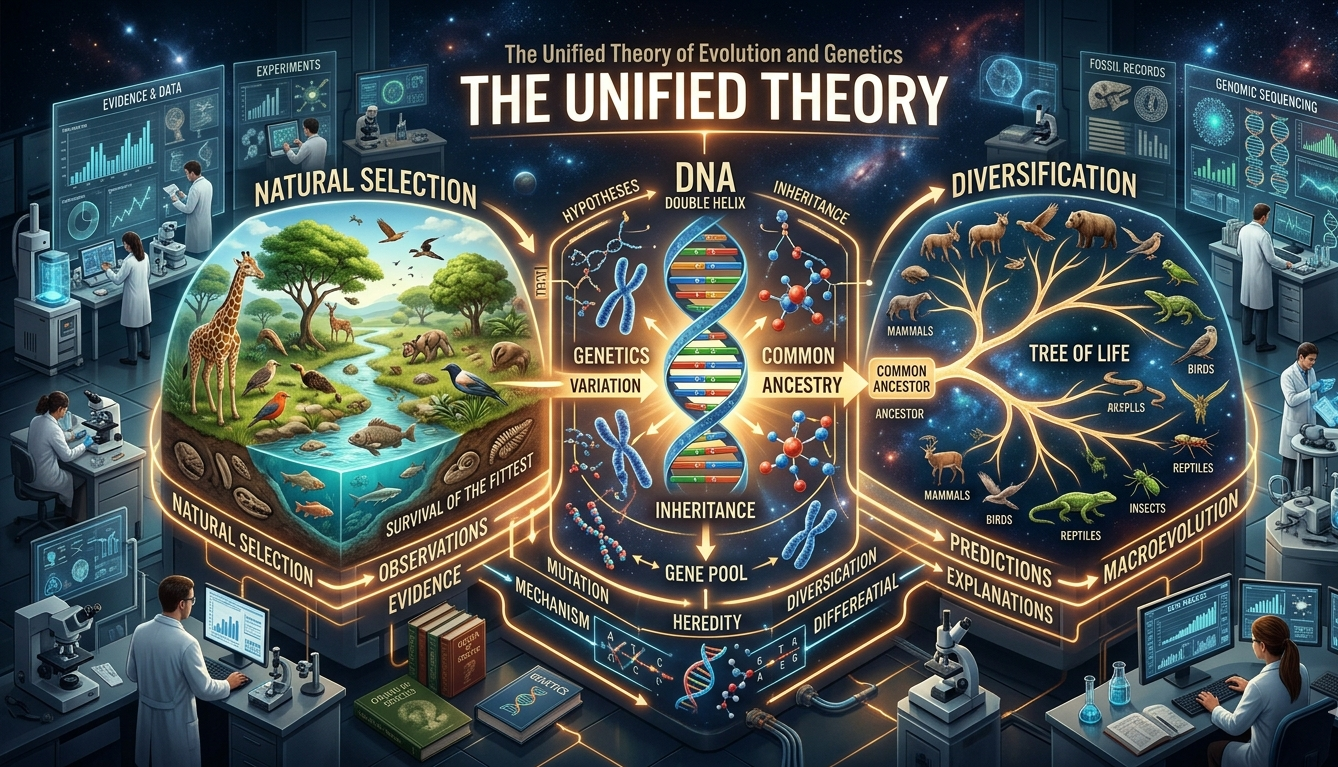
Science has always been humanity’s way of exploring the unknown. From the movements of the stars to the behavior of microscopic cells, humans have sought to understand how the world works. One of the key tools in this quest is the scientific theory. A scientific theory is more than just a guess or a simple idea; it is a comprehensive explanation of a natural phenomenon that has been rigorously tested and supported by substantial evidence. It forms the backbone of scientific understanding and helps us make sense of the universe in an organized and predictable way.
What Is a Scientific Theory?
At its core, a scientific theory is a well-substantiated explanation of some aspect of the natural world. Unlike everyday use of the word “theory,” which often implies speculation, in science, a theory is the result of careful observation, experimentation, and reasoning. It is developed from a body of evidence collected over time and must consistently explain observed facts while making accurate predictions about future phenomena.
For example, the theory of gravity explains why objects fall to the ground, why planets orbit stars, and why tides rise and fall. This theory has been tested countless times, both in everyday life and in controlled experiments, making it one of the most reliable explanations in science. A scientific theory is not static; it can be refined or even replaced if new evidence challenges its accuracy, reflecting the dynamic nature of scientific inquiry.
Early Life and Background of Scientific Thinking
The roots of modern scientific theories can be traced back to ancient civilizations. Early humans observed patterns in nature and attempted to explain them through myths or simple reasoning. For example, the ancient Greeks noticed patterns in celestial movements and began developing early models of the universe. Figures like Aristotle and Ptolemy laid foundational ideas, though their explanations were often limited by the technology and knowledge available at the time.
The modern concept of a scientific theory emerged during the Renaissance, a period of rapid learning and discovery. Scientists began using experiments, systematic observations, and mathematical reasoning to explain natural phenomena rather than relying solely on philosophical or religious interpretations. One influential figure was Galileo Galilei, who used careful observations and experiments to challenge long-held beliefs about motion and astronomy. Galileo’s work highlighted the importance of evidence-based reasoning, a cornerstone of scientific theory.
Another key figure in the development of scientific theories was Sir Isaac Newton. Newton’s laws of motion and universal gravitation provided a framework for understanding physical phenomena on Earth and in the heavens. His work exemplifies how a scientific theory integrates observation, experimentation, and mathematical explanation to form a coherent understanding of nature.
Characteristics of a Scientific Theory
Scientific theories share several important characteristics that distinguish them from casual ideas or guesses. Firstly, they are supported by a large body of evidence. A theory cannot survive rigorous scientific scrutiny unless repeated experiments and observations support it. Secondly, scientific theories are testable and falsifiable. This means that they make predictions that can be tested through experimentation, and there must be a possibility that observations could prove the theory wrong. Thirdly, scientific theories are consistent with existing knowledge, integrating well with other well-established scientific principles. Finally, they are dynamic. As new data emerges, theories can be refined, expanded, or replaced, demonstrating the self-correcting nature of science.
Examples of Scientific Theories
There are countless examples of scientific theories that have shaped our understanding of the world. The theory of evolution, proposed by Charles Darwin, explains how species change over time through natural selection. This theory has been supported by extensive fossil evidence, genetic studies, and observations of living organisms. It provides a unifying framework for understanding the diversity of life on Earth.
Another example is the theory of relativity, developed by Albert Einstein. This theory revolutionized our understanding of space, time, and gravity. It replaced earlier concepts of absolute time and space, demonstrating that time can bend and stretch depending on speed and gravity. Einstein’s theory not only explained phenomena that classical physics could not, such as the behavior of light near massive objects, but it also led to practical applications like GPS technology, which relies on adjustments based on relativity.
The germ theory of disease, established in the 19th century by scientists like Louis Pasteur and Robert Koch, provides yet another example. It explains that microorganisms are responsible for many diseases, replacing earlier ideas of illness caused by “miasma” or bad air. This theory revolutionized medicine, leading to modern practices such as sterilization, vaccinations, and antibiotics.
The Process of Developing a Scientific Theory
Developing a scientific theory is a meticulous and rigorous process. It usually begins with careful observation of a phenomenon that sparks curiosity or raises questions. Scientists then formulate hypotheses—testable predictions about how the phenomenon works. These hypotheses are subjected to repeated experimentation and observation. Data collected from these experiments is analyzed to determine patterns and consistency.
Once enough evidence accumulates, and the explanations can reliably predict outcomes, a hypothesis may evolve into a scientific theory. Even after becoming a theory, it is continually scrutinized, tested, and refined as new evidence emerges. This rigorous process ensures that scientific theories remain reliable explanations of natural phenomena.
Achievements and Legacy of Scientific Theories
The impact of scientific theories is profound and far-reaching. They have enabled humanity to make incredible achievements in medicine, technology, space exploration, and understanding of the universe. For instance, the development of the atomic theory of matter paved the way for modern chemistry and physics, including nuclear energy and material science. The theory of plate tectonics revolutionized geology, explaining earthquakes, volcanoes, and the movement of continents.
Scientific theories also provide a foundation for ongoing research and discovery. By offering a framework for understanding phenomena, they guide experiments, inform technological innovations, and influence policies related to health, environment, and society. The legacy of scientific theories is evident not only in the knowledge they provide but also in their ability to inspire further inquiry and understanding.
The Difference Between a Scientific Theory and a Hypothesis
It is important to distinguish between a scientific theory and a hypothesis. A hypothesis is an initial, testable idea about a phenomenon, often based on limited evidence. A scientific theory, on the other hand, is a comprehensive and well-supported explanation that has undergone extensive testing and validation. While a hypothesis may evolve into a theory if supported by sufficient evidence, not all hypotheses reach this stage. Understanding this distinction helps avoid confusion and emphasizes the strength and reliability of scientific theories.
Common Misconceptions About Scientific Theories
Many people misunderstand the meaning of “theory” in everyday language, assuming it implies uncertainty or mere speculation. In science, however, a theory represents the highest level of understanding and is backed by substantial evidence. For example, the theory of gravity or the theory of evolution is not “just a guess.” These theories have withstood extensive scrutiny and consistently explain and predict natural phenomena.
Another misconception is that scientific theories are unchangeable. In reality, they are dynamic and can be refined or replaced as new evidence emerges. This adaptability is a strength rather than a weakness, as it reflects the self-correcting nature of science and ensures that our understanding becomes increasingly accurate over time.
The Importance of Scientific Theories in Daily Life
Scientific theories affect our daily lives in ways we often take for granted. The germ theory of disease informs how we practice hygiene, vaccinations, and medical treatments. The theory of gravity allows engineers to construct safe buildings, bridges, and transportation systems. Understanding the principles of thermodynamics enables the design of efficient engines, refrigerators, and heating systems. Even the GPS in our smartphones relies on Einstein’s theory of relativity to provide accurate location data. These examples demonstrate that scientific theories are not abstract ideas; they are practical tools that improve the quality of life and enable technological progress.
Conclusion
A scientific theory is much more than a simple idea; it is a rigorous, evidence-based explanation of natural phenomena that helps humans understand the world. From its early roots in ancient observation to the sophisticated theories of modern science, the development of scientific theories has been a journey of curiosity, experimentation, and discovery. They guide research, inform technology, and impact everyday life in profound ways. By understanding the nature, process, and significance of scientific theories, we gain insight into the remarkable ways humans make sense of the universe. Whether explaining the orbit of planets, the behavior of atoms, or the evolution of life, scientific theories continue to illuminate the mysteries of the natural world, forming a legacy of knowledge that will inspire generations to come.